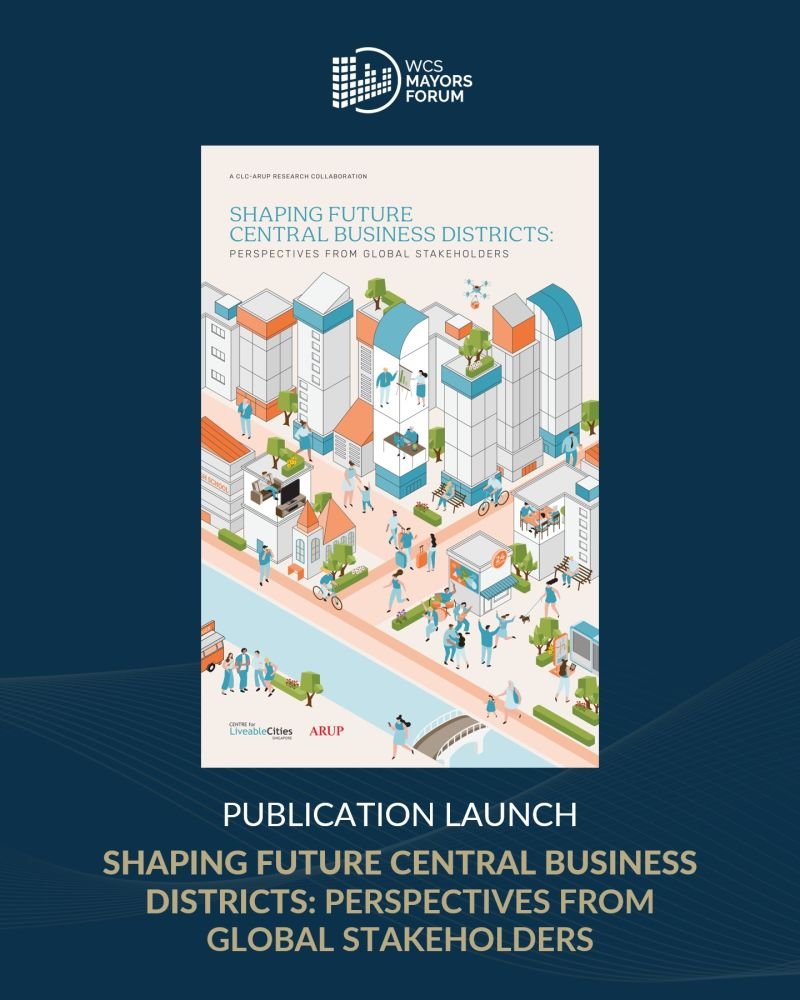
A new global publication on the future of city centres – Shaping Future Central Business Districts: Perspectives from Global Stakeholders – has just been released by Singapore’s Centre for Liveable Cities (CLC) in collaboration with Arup. The report was officially launched at the World Cities Summit Mayors Forum 2025 in Vienna and brings together lessons from cities that are rethinking how their downtowns work in an era of hybrid work, climate risk and shifting urban economies.
Central Business Districts (CBDs) worldwide are at an inflection point. Many are moving away from a single-use, office-heavy model toward mixed-use, 24-hour districts that combine workplaces with housing, culture, education, hospitality and public life. The CLC–Arup study distils strategies from cities including Singapore, Sydney, Bangkok, Glasgow, New York and Bogotá, highlighting how they are reshaping governance, mobility, ground-floor uses and public realm to keep their centres vibrant and resilient.
Andrew’s role in a global CBD conversation
Over the past 18 months, Reactivate Co-founder and Director Andrew Coward has contributed to the development of the publication through a series of roundtables convened by CLC and Arup. These conversations brought together city leaders, public realm practitioners and downtown organisations from around the world – including Ya-Ting Liu (Chief Public Realm Officer, NYC), Koen Kennis (Vice Mayor, Antwerp), Susan Aitken (Council Leader, Glasgow), as well as local partners such as Committee for Sydney, City of Sydney and Arup Australia.
Andrew’s contribution drew on Reactivate’s experience across Sydney’s CBD and innovation precincts, as well as our work in downtown and waterfront districts globally, focusing on:
How ground-plane strategy and activation can support a shift from nine-to-five business districts to all-day, all-week destinations.
The role of data, visitation patterns and programming in keeping CBDs “alive” between major events or office peaks.
Practical governance and partnership models that help city governments, BIDs, landowners and cultural partners work together on shared outcomes.
Reactivate’s lens throughout has been clear: CBD transformation is not just about real estate and transport – it is about public life, the experience at street level, and how people actually use city centres across seasons, time of day and stages of life.
Key themes from Shaping Future Central Business Districts
While each case study follows a different path, the publication surfaces several common directions that strongly align with our work at Reactivate:
From office core to mixed-use neighbourhood
CBDs can no longer rely solely on premium office towers. The report shows cities using tools such as adaptive reuse, incentive schemes and zoning flexibility to bring in housing, education, culture and social infrastructure alongside employment.
Public realm and mobility as catalysts
Streets, squares, waterfronts and active mobility networks emerge as core levers for change – from Glasgow’s Avenues Programme to Singapore’s walkability and transit-oriented initiatives – turning once car-dominated business districts into places where walking, cycling and public life come first.
Programming and identity, not just hardware
Many featured cities are investing in events, cultural programming, night-time economy initiatives and creative districts to give their CBDs a stronger identity and a reason to visit outside business hours.
Resilience, climate and data
Climate adaptation, energy transition and heat mitigation are increasingly embedded into CBD strategies. At the same time, cities like Sydney and Glasgow are using dashboards and performance metrics to track visitor flows, economic activity and public space use – turning data into a feedback loop for better decision-making.
Collaboration across sectors
A recurring message is that successful CBD renewal depends on coalitions of government, business and communities working together over the long term, rather than one-off projects or single-agency initiatives.
Why this matters for our work
For Reactivate, this publication is a valuable reference point for clients working on downtown revitalisation, waterfront renewal and innovation precincts – in Australia, Canada and beyond. It reinforces many of the principles we apply in practice:
Start with public life and experience rather than just land use.
Treat CBDs as mixed, lived-in districts, not just employment zones.
Pair physical change with governance, programming and partnerships.
We’re thrilled to see Andrew’s insights reflected alongside contributions from leading cities and practitioners worldwide, and we’re looking forward to bringing these global lessons into our next generation of CBD and city centre projects.
Explore Shaping Future Central Business Districts: Perspectives from Global Stakeholders via the Centre for Liveable Cities Knowledge Hub to see how cities around the world are reimagining their downtowns for resilience and everyday life: https://knowledgehub.clc.gov.sg/publications-library/shaping-future-central-business-districts-perspectives-from-global-stakeholders/